BlogGlo & Sparkle

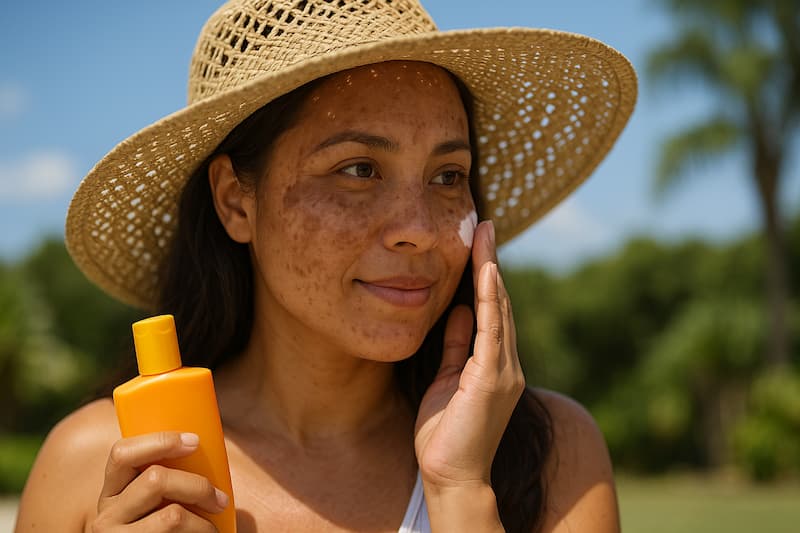
Sunscreen has somehow become one of the most suspicious products in the bathroom cabinet. Scroll long enough, and you will find claims that chemical sunscreen is toxic, mineral sunscreen is the only safe option, all sunscreen blocks vitamin D, SPF 100 is basically impenetrable armor, and that sunscreen itself causes cancer. Some of these arguments started with a real fact and then sprinted several miles past the evidence.
At Glo & Sparkle, we are very comfortable questioning skincare claims. Plenty of beauty advice deserves skepticism. The evidence that sunscreen protects our skin from ultraviolet radiation is strong, while many of the scariest claims online rely on a much looser standard.
So yes, read the label, ask questions, and be picky about texture and ingredients. Just make sure the skepticism is aimed in the right direction.
A lot of sunscreen anxiety traces back to studies showing that several chemical sunscreen ingredients can be absorbed through the skin and detected in the bloodstream. This is one reason the FDA has continued asking manufacturers for more safety data on several active ingredients.
Detection in the bloodstream does not establish that an ingredient is causing harm at the levels detected. The safety question requires its own evidence.
The FDA still recommends sunscreen as part of a broader sun-protection strategy, and the American Academy of Dermatology continues to recommend broad-spectrum sunscreen with SPF 30 or higher. In 2026, the FDA also added bemotrizinol as a permitted sunscreen ingredient after reviewing its safety and effectiveness data.
At the same time, regulators are not frozen in place. In September 2026, the FDA removed PABA and trolamine salicylate from the over-the-counter sunscreen monograph after concluding that their risks outweighed their benefits. That's an important fact to note for anyone reading old sunscreen warnings online. The ingredient list and the regulatory picture are still being updated as evidence changes.
Mineral sunscreens, also called physical sunscreens, use zinc oxide, titanium dioxide, or both. Chemical sunscreens use active ingredients such as avobenzone, octisalate, octocrylene, and others.
The familiar internet explanation says mineral sunscreen acts like a mirror while chemical sunscreen simply sinks into the body. The chemistry is less dramatic.
Both mineral and chemical sunscreens primarily work by absorbing UV radiation and converting that energy into a small amount of heat. Zinc oxide and titanium dioxide also reflect and scatter some UV rays at the skin’s surface.
For most people, the useful differences are formulation, skin type, and wearability. Both categories can provide effective sun protection when the product offers broad-spectrum protection and is applied correctly.
Mineral sunscreens can be a good fit for sensitive skin and may be less likely to sting. They can also feel thicker or leave a visible cast, especially on deeper skin tones. Chemical sunscreens are often lighter and easier to wear under makeup, but certain formulas can irritate sensitive skin or sting around the eyes.
The best sunscreen is the one you can apply correctly and wear consistently.
SPF stands for sun protection factor, and it gets most of the attention because it is the big number on the bottle. SPF primarily tells you about UVB protection, the part of ultraviolet radiation most associated with sunburn.
UVA rays reach deeper into the skin and contribute to premature aging, pigment changes, collagen breakdown, and skin cancer risk. Broad-spectrum sunscreen is designed to protect against both UVA and UVB rays.
That is why we look for the words broad spectrum. Broad-spectrum sunscreen protects against both UVA and UVB rays.
For everyday use, dermatology organizations generally recommend SPF 30 or higher. Higher SPF does increase UVB protection, but the jump is smaller than the numbers make it look. SPF 30 filters about 97% of UVB rays when applied correctly.
The larger problem is that most people do not apply enough sunscreen in the first place. For exposed skin on the body, dermatology guidance commonly uses about one ounce, roughly a shot-glass amount, as a practical benchmark. Apply it before heading outside so the product has time to form an even protective film.
SPF 50 does not mean you can apply sunscreen once in the morning and forget about it until dinner.
Sunscreen wears off. Sweat, water, towels, friction, and time all reduce the amount sitting evenly on the skin.
When you are outdoors, reapply sunscreen about every two hours and after swimming or heavy sweating. Apply sunscreen generously to exposed skin, including easy-to-miss areas such as the ears, neck, chest, and backs of the hands. Water-resistant products are tested for either 40 or 80 minutes in water, and no sunscreen is truly waterproof.
Application habits are far less interesting than ingredient arguments online, but they have a much bigger effect on whether the product actually works.
You can still get meaningful UV exposure on cloudy days.
Clouds can reduce some UV radiation, but they do not eliminate harmful UV rays. UVA also passes through window glass more effectively than UVB, which is one reason long periods near windows or in a car can still contribute to cumulative sun exposure and skin damage.
In West Texas, we also have a lot of open sky and high cumulative sun exposure across the year. Sunscreen makes more sense as part of a daily skin-health routine than something reserved for pool days.
A wide-brimmed hat, sunglasses, shade, and protective clothing also count. Clothing with a high ultraviolet protection factor can add another layer of skin protection. Sunscreen should not have to do every job by itself.
The vitamin D argument starts with a real biological fact: your skin uses UVB exposure to produce vitamin D. From there, the claim often gets stretched into the idea that regular sunscreen use causes deficiency. Human behavior makes that equation much less tidy.
No sunscreen blocks 100% of UV radiation, and typical sunscreen use has not been shown to eliminate vitamin D production. Diet and supplementation can also provide vitamin D without relying on intentional UV damage.
If you are worried about your vitamin D level, a blood test gives you a much better answer than deliberately leaving your skin unprotected.
Melanin provides some natural protection from ultraviolet radiation, but it is not enough to make sunscreen irrelevant. People with deeper skin tones can still develop skin cancer, photoaging, dark spots, and uneven skin tone from UV exposure. Pigment concerns can be especially stubborn because both UV and visible light can worsen discoloration in some skin types.
Tinted mineral sunscreens that contain iron oxides can be useful for patients dealing with melasma or other pigment issues because they can add visible-light protection along with UV protection.
The practical challenge is finding a formula that looks good enough on the skin to wear every day. White cast is not a trivial complaint.
Coconut oil, shea butter, seed oils, and homemade sunscreen recipes get passed around as gentler alternatives. They are not reliable substitutes for a tested sunscreen.
A sunscreen sold in the United States has to meet labeling and performance requirements. Kitchen oils do not give you a dependable SPF, broad-spectrum protection, or predictable coverage.
Natural ingredients can be perfectly useful in skincare, but they do not become sunscreen simply because they came from a plant.
Spray sunscreens can work. The issue is how easy it is to under-apply them.
A quick mist over an arm may look thorough while leaving gaps between droplets. Wind can also carry product away before it reaches the skin.
If you use a spray, apply enough to visibly cover the area, rub it in when the label directs you to, and avoid inhaling the product. Lotion, cream, stick, and spray formulas can all work when enough product actually reaches the skin.
We spend a lot of time helping patients improve sun damage, uneven skin tone, redness, texture, and premature aging.
Skipping sunscreen while treating those concerns makes the results harder to protect.
UV exposure can darken pigment, break down collagen, and make it harder to maintain results from treatments aimed at improving tone and texture. Daily sun protection helps protect the work done with medical-grade skincare, skin analysis, and treatments such as Stellar M22 for sun damage and pigmentation.
This is especially important after procedures that temporarily make the skin more sensitive to UV exposure.
You do not need to become loyal to one sunscreen category. Choose a broad-spectrum SPF 30 or higher that suits your skin type and routine. The best sunscreen is one you can use in a consistent application habit without fighting the formula every morning. If your skin is sensitive, mineral sunscreen may be easier to tolerate. If a chemical or hybrid formula disappears beautifully under makeup and keeps you consistent, that matters too.
Look for water resistance when you are swimming or sweating. Reapply when you are outdoors. Do not assume makeup with SPF gives enough coverage on its own, since most people apply far less makeup than the amount used to test sunscreen. Replace expired sunscreen, and if a bottle has no expiration date, do not keep it indefinitely. Add hats, shade, and protective clothing when exposure is high.
And if a product makes your skin sting, break out, or react, switch formulas rather than abandoning sun protection altogether.
We are not interested in telling patients to stop asking questions about sunscreen.
The questions are good.
The problem starts when “this ingredient was detected in blood” becomes “this ingredient is poisoning you,” or when “mineral sunscreen is a good option” turns into “everything else is dangerous.”
Current evidence still supports sunscreen as a useful tool for reducing UV damage, sunburn, premature aging, and skin cancer risk. The regulatory picture continues to evolve, and that is a reason to keep following the evidence, not a reason to throw out sun protection.
At Glo & Sparkle, we would rather help you find a sunscreen you can actually live with than pretend one bottle works for everyone. If your current formula feels greasy, irritating, chalky, or impossible under makeup, bring that problem to us. We can help build a routine that protects your skin without making your morning routine unbearable.
schedule your consultation with Glo & Sparkle
We are a one-of-a-kind top-tier MedSpa in Lubbock with the latest, widely studied, scientifically proven, and FDA cleared technology, including the Emsculpt NEO, Emsella, Stellar M22 Laser, Genius Radiofrequency Microneedling, SkinPen Microneedling, OxyGeneo, Advanced PDO thread Lifts and 3D photography.. So you can be comfortable knowing that at Glo and Spa-rkle, you will get a thorough and detailed consultation, with an optional but recommended low-cost, state-of-the-art 3D photography evaluation of the face and body.
This thorough consultation will give you accurate information and “before-photos” to develop your aesthetic plan and follow-up “after-photos” to help you get precise information and visual data to track your progress along your aesthetic journey!
4513 114th St, Lubbock, TX 79424